25 Years of Progress: WHCRWA’s Milestones and Future Plans
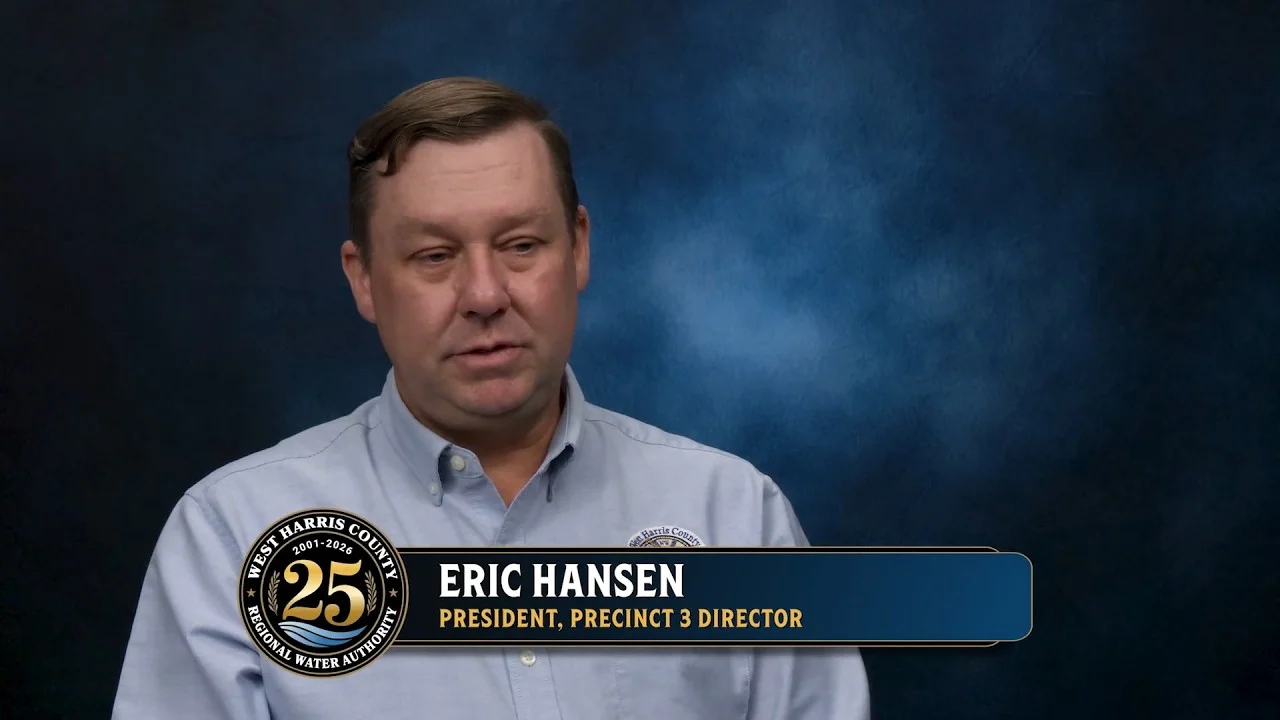
During the West Harris County Regional Water Authority’s Central Pump Station Open House on October 10, 2026, visitors had the opportunity to watch a narrated PowerPoint presentation by Eric Hansen, WHCRWA Board President and Precinct 3 Director. The presentation was converted to video and played on a continuous loop throughout the event.
The video looks back at the Authority’s first 25 years, highlighting the milestones, partnerships, and infrastructure investments that have shaped the region’s transition from groundwater to surface water. It also covers major regional water projects, groundwater reduction milestones, water rates, financial planning, and the June 2026 startup of the Central Pump Station.
Looking ahead, the presentation outlines WHCRWA’s continuing efforts to meet the 80% groundwater reduction requirement by 2035.
A transcript of the presentation is provided below the video for reference.
I would like to share a few slides with you about the Authority and what we have accomplished in our short 25-year history, and our plans for moving forward.
2026 marks the 25th anniversary of the creation of the West Harris County Regional Water Authority. A lot has happened in the past 25 years, and we are proud to share those accomplishments with you.
The Authority was created in 2001. This is also the same year that we entered into a water supply contract with the City of Houston, establishing 28.25 million gallons of treated surface water per day for the Authority.
Our first surface water was delivered to MUD 179 in the Copperfield area beginning in 2005, through a direct connection to the City of Houston’s 24-inch water line on FM 529. This early surface water delivery allowed the Authority to start earning over-conversion credits from the Harris-Galveston Subsidence District.
In 2006, the Authority purchased a 44-mile-long easement from ExxonMobil Corporation, which ran across Houston and Harris County to the Katy gas fields. This easement provided a ready-made route for our large-diameter Surface Water Supply Project pipeline. This pipeline easement allowed for construction of our Surface Water Supply Project’s 96- and 84-inch pipelines from the Northeast Water Purification Plant at Lake Houston all the way out to Interstate 10 and the Grand Parkway in Katy. The purchase of this easement saved the Authority significant time and acquisition cost compared to more traditional easement acquisition methods.
In 2008, our Pump Station No. 1 was completed and became operational, allowing for additional early surface water delivery projects to begin. Pump Station No. 1 has a pumping capacity of up to 60 million gallons per day.
Then, in 2010, the Authority met the Harris-Galveston Subsidence District’s 30% conversion requirement on time. Our conversion in that first year was 31.4%.
During the period from 2010 to 2015, the Authority focused on strategic planning and partnerships. In 2010, we established the Joint Facilities Agreement with the North Fort Bend Water Authority for the Bellaire Pump Station and the large-diameter water distribution pipeline known as the Surface Water Supply Project.
In 2014, we executed the second supplemental agreement with the City of Houston, which established the financial partnership and Authority representative roles for construction of the 320-million-gallon-per-day Northeast Water Purification Plant Expansion Project. That contract was awarded at the end of 2015 as the largest progressive design-build contract in the country at the time, and possibly the world, with a construction cost of $1.765 billion.
In 2016, we began awarding design contracts for the Surface Water Supply Project. That project was needed for our 60% and 80% conversion to surface water and includes approximately 55 miles of large-diameter pipe, two pump stations, and three meter stations. This project had 24 design contracts.
Beginning in 2018, the Northeast Water Plant early-work construction packages began, and construction on that project has continued through the end of 2026.
2019 was a busy year for the Authority. In 2019, the Authority began construction on our 55-mile large-diameter Surface Water Supply Project pipeline, beginning with Segment S3-A4. Segments C1 and C2 began construction soon after in 2020. Additionally, the Northeast Water Plant expansion balance-of-plant construction contracts were also started in 2019.
Then, in 2021, the Authority began to negotiate contracts on our internal CIP, or Capital Improvement Program, design projects. These projects are critical to being able to meet the Harris-Galveston Subsidence District’s 60% surface water conversion requirement.
As we look back at more recent years, the hard work from the early years has moved from concept to reality.
Phase 1 of the Northeast Water Plant came online in 2024 and began delivering 80 million gallons per day of treated surface water to the City of Houston for delivery to the water authorities through the Northeast Transmission Line.
By 2025, the Authority began construction of the CIP distribution lines needed to continue expanding surface water delivery and meet the Subsidence District’s regulatory milestones.
By May of 2026, the Northeast Water Plant Phase 2 was complete and capable of delivering an additional 240 million gallons of treated surface water per day. The Surface Water Supply Project pipeline was also completed and disinfected in May.
Then, on June 2, 2026, the Central Pump Station, the facility that you are in today, began pumping treated surface water from the Northeast Water Plant at an initial rate of approximately 21 million gallons per day.
As we head into 2027 and 2028, we will continue converting additional water plants to surface water as the pump station, Segment 3 lines, and remaining CIP distribution lines are completed. At this point, conversion is an ongoing process of expanding surface water delivery as the system grows and we work toward future regulatory milestones.
As we progress toward the Subsidence District’s 80% conversion requirement in 2035, the Authority will continue earning additional over-conversion credits while also planning, designing, and constructing additional CIP distribution projects.
As we look back at some of the West Harris County Regional Water Authority’s critical statistics, there is an estimated population of approximately 648,500 people within the Authority’s boundaries. The Authority’s groundwater reduction plan area covers approximately 232 square miles and includes more than 150 MUD districts, as well as portions of the City of Katy.
Today, the Authority has 81.9 miles of internal water distribution lines, delivering surface water to 69 water plants. Approximately nine additional miles are under construction, with an additional 17.3 miles of water line currently in design through our Capital Improvement Program.
The Authority met and exceeded the 30% conversion requirement in 2010 and successfully met the 60% requirement in 2025. As the system continues to grow, we will continue converting additional water plants to surface water as we work toward the 80% regulatory milestone in 2035, when more than 140 water plants are expected to be connected through over 165 miles of internal distribution lines.
As we look at the broader regional approach to subsidence, we can see that these projects traverse three counties and involve five partners, as well as including water lines up to 10 feet in diameter. Together, we have spent $4.25 billion on regional projects to fight subsidence.
We start with the Luce Bayou Interbasin Transfer Project and the Capers Ridge Pump Station, with a cost of $350 million. This project was delivered by the Coastal Water Authority and is funded in part by the City of Houston, the West Harris County Regional Water Authority, the North Harris County Regional Water Authority, the Central Harris County Regional Water Authority, and the North Fort Bend Water Authority.
The Luce Bayou Project takes approximately 500 million gallons of water per day from the Trinity River and transfers it to the headwaters of Lake Houston, where it’s made available to the Northeast Water Purification Plant Expansion Project.
The 320-million-gallon-per-day Northeast Water Plant Expansion Project, known as Plant 2, is a joint project of the City of Houston and the four regional water authorities, with a completed cost of $1.97 billion and $1.75 billion in construction costs. The Northeast Water Plant Expansion Project was the largest progressive design-build project in the country at the time it was awarded in 2015.
Additionally, the City of Houston and [unclear in source transcript] Central Harris County Regional Water Authorities participated in the $450 million Northeast Transmission Line. This large-diameter pipeline delivers treated surface water from the Northeast Water Plant to the Central and North Harris County Regional Water Authority boundaries.
Meanwhile, the West Harris County Regional Water Authority and the North Fort Bend Water Authority have jointly participated in and built the $1.45 billion Surface Water Supply Project, which encompasses over 55 miles of 84-inch and 96-inch large-diameter pipelines, two pump stations, and three meter stations.
Together, the City of Houston and the regional water authorities have spent in excess of $4.25 billion on these regional projects, not including additional dollars spent on their internal distribution pipes connecting surface water to cities and MUD districts.
Most of the graphics on this slide have already been discussed. We’ve already talked about the pipelines, 55 miles in length, and two pump stations. Pay attention to the pipe graphic in the middle that shows an average person standing next to our 96-inch-diameter pipes. A full-size pickup truck can fit inside these eight-foot-diameter pipes.
While the Authority has managed the Surface Water Supply Project, the Authority’s share of this project is 55% of the total cost, which is approximately $785 million.
This map shows the Authority’s internal Capital Improvement Program (CIP) and how the distribution system continues to expand. It identifies our existing CIP water lines, projects currently under construction, projects in design, and preliminary future projects.
Today, the Authority is delivering surface water to 69 water plants. Approximately nine additional miles of water line are currently under construction, with another 17.3 miles in design. As these projects are completed, the system will continue to grow and additional water plants will be converted to surface water as we work toward the Subsidence District’s 2035 regulatory milestone.
No presentation about the Water Authority would be complete without a discussion on water rates.
As we look over the past 25 years, we can see when the Authority was created, it took the approach that water rates should rise steadily and predictably as our projects began to take [unclear in source transcript]. The graph shown in front of you shows that our water rates have done just that and climbed predictably to a peak of $3.95 for groundwater pumping and $4.35 for surface water delivered, per thousand gallons. Those rates have been unchanged since 2023, and the Authority has recently announced that there will not be a rate increase in January of 2027.
Also of note with this chart is the Harris-Galveston Subsidence District’s disincentive fee. This fee is tied directly to the City of Houston water rates with a multiplier. As you can see, it has increased much more dramatically than the Authority’s water rates. As the title describes, disincentive is an accurate description at $12.52 per thousand gallons today. The Authority has worked hard over the past 25 years to make sure that we are meeting the Harris-Galveston Subsidence District’s surface water conversion mandate so that none of us have to pay the disincentive fee.
This chart shows the Authority’s 30% conversion efforts and how we leveraged over-conversion to accumulate over-conversion credits. From the time we first started taking surface water from the City of Houston and began our conversion process, we began accumulating over-conversion credits as we exceeded the applicable conversion requirements.
The Authority met the 30% requirement in 2010 and consistently exceeded that requirement in the years that followed, earning more than 36.8 billion gallons of over-conversion credits through the end of 2024. These credits are currently being used for our 2025, 2026, and 2027 permits as we complete our 60% conversion program buildout through the middle of 2027.
Once this program is complete, and as we progress into our 2035 program, we expect to earn additional over-conversion credits beginning in 2027, which will further help us achieve our ultimate 80% conversion requirement in the most cost-effective and efficient way possible.
The Authority’s historical approach to water rates has been to use construction cost estimates and rate studies to predict bond sales and our required water rate. We then gradually increased our water rates in a consistent and predictable manner up to the necessary level. As that has happened, our rates have increased prior to construction due to state regulations regarding construction funding. One hundred percent of our project costs have to be available and in the bank before we can start a construction project.
This has been one of the reasons that our account balances have been so large going into the 60% conversion program. The magnitude of the cost of these projects, having to have all that money in the bank on day one, required significant bond sales as well as the water rates to support the debt service on those bonds.
As you may recall from our previous slides, the Authority has not increased its water rate since 2023, and rates will remain unchanged in 2027. As these projects are being completed within the estimated budget, there has not been a recent need to raise rates or sell additional bonds.
As we move into the future, the Authority will continue the same approach to water rates that it has in the past. We will continue utilizing rate studies, with our next rate study coming in mid-2027. When it becomes necessary, the Authority will gradually increase water rates as needed in a consistent and predictable manner.
As we complete our 60% projects and begin our 80% projects through 2035, we will also use available cash in our improvement fund that’s been accumulated through earned interest on our bonds, as well as unused contingency funds. Our intent is to continue to keep our water rates as low as possible for as long as possible, and to be consistent and judicious when increases are necessary.
What will our water rates be in the future? Quite honestly, it’s too early to tell. There are several factors that go into what that rate might be. As we pay down our earliest bonds, we gain the ability to sell new bonds without affecting our rates. We also expect to have unused contingency funds, as well as accrued interest over the past several years, that will be reinvested in accelerated projects that will help to both reduce the need for new bonds while maximizing the earning of additional over-conversion credits.
As we approach the 80% conversion in 2035, this will help to minimize the need for future rate increases.
As we talked about earlier, the Authority is already in the planning stages for the 80% conversion requirement in 2035. We are currently working on route alignment and easement acquisition for this next phase of CIP projects, which is expected to include the City of Katy as the system continues to expand.
We anticipate having more than 144 miles of water line in total and more than 140 water plants connected to surface water. The additional projects are expected to be constructed through approximately 10 to 20 delivery contracts, with water line sizes ranging from 12 inches to 54 inches.
This concludes today’s presentation.
Transcript edited for clarity and readability