
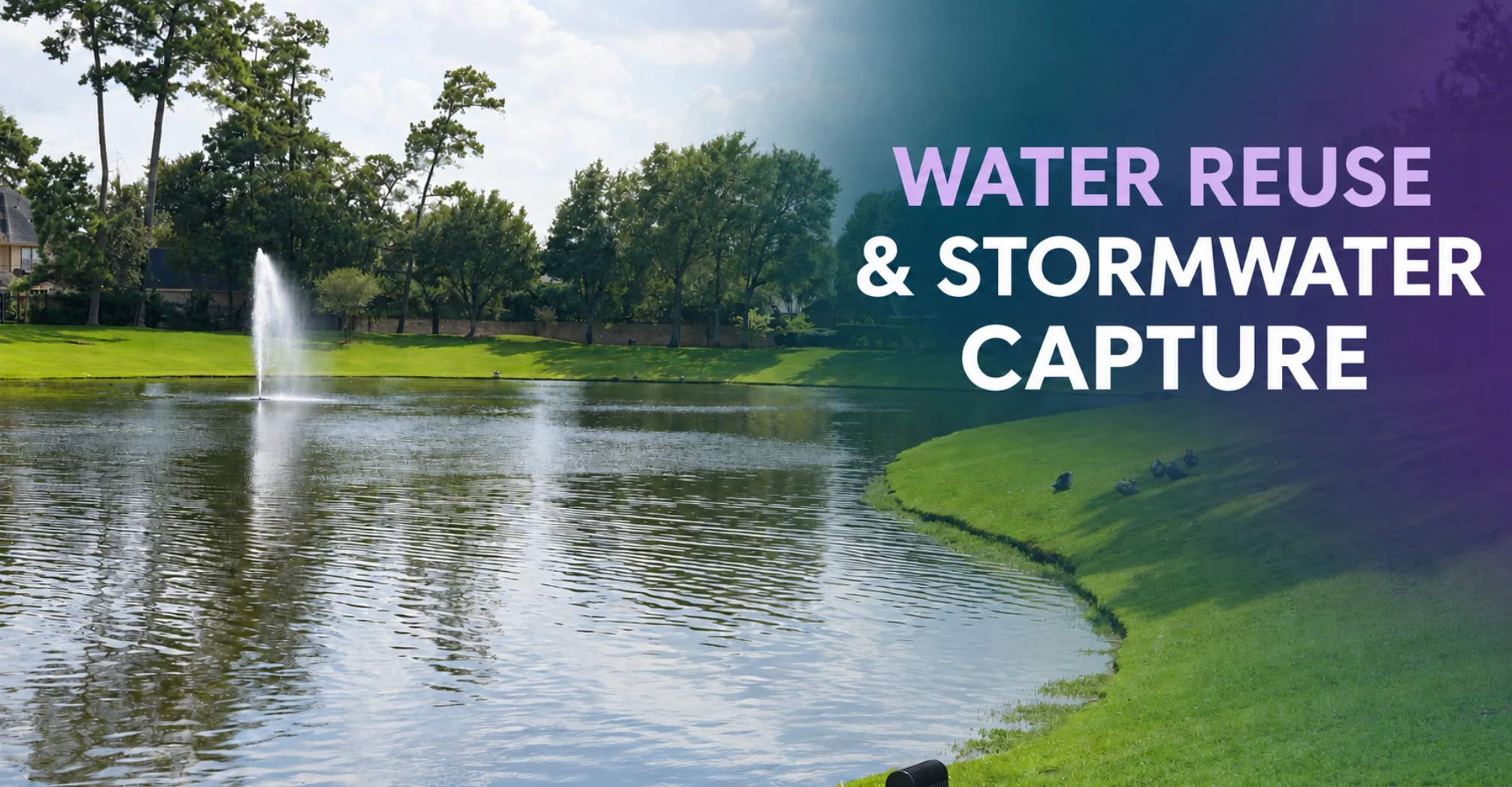
Municipal Utility Districts (MUDs) and other water providers can conserve groundwater by reusing treated wastewater and captured stormwater for irrigation and other approved purposes.
The West Harris County Regional Water Authority (WHCRWA) encourages these efforts through its Alternate Water Credit Agreement Policy, which provides financial incentives for qualifying projects.
What Are Alternate Water Credits?
In 2011, WHCRWA adopted a policy encouraging water providers to invest in alternative water supplies that reduce groundwater demand.
Qualifying projects generally fall into three categories:
- Water Reuse: Using treated wastewater, also called effluent, for approved non-drinking purposes, such as irrigating public green spaces and golf courses. Certain projects also reuse treated drinking water for non-drinking purposes.
- Stormwater Capture: Collecting and reusing rainfall runoff, including water captured in detention basins.
- Other Surface Water Sources: Using untreated water from streams, bayous, or other surface water sources where appropriate water rights are available.
These approaches allow participating water providers to reduce groundwater pumping while putting available water resources to beneficial use.
How WHCRWA’s Credit Program Works
Under the program, WHCRWA and a participating water provider enter into an agreement for an eligible alternative water project.
The participating entity is responsible for financing, designing, and constructing the necessary facilities. Once the project is operating, the provider documents and reports its alternative water use.
- Credits are calculated using measured alternative water consumption.
- The credit value is equivalent to one-half of the applicable WHCRWA fee per 1,000 gallons.
- Credits are applied to future WHCRWA invoices after the Authority receives the corresponding over-conversion credits from the Harris-Galveston Subsidence District.
- Depending on the agreement and project, credits may be limited to 10 years, eligible documented capital construction costs, or both.
The financial benefit is provided through credits against WHCRWA charges rather than direct cash payments.
A Proven Conservation Strategy
As reported in WHCRWA’s Summer 2025 Partners in Progress newsletter, the program had supported 10 alternative water projects since its establishment in 2011:
- 5 water reuse projects
- 4 stormwater capture projects
- 1 direct surface water project
These projects had generated:
- More than $5.1 million in credits awarded to participating water providers.
- Nearly $4.8 million in capital construction cost reimbursement through credits.
- An estimated $9.95 million in combined savings, including avoided groundwater pumpage and surface water costs.
- More than 29.3 billion gallons in over-conversion credits earned by WHCRWA from the Harris-Galveston Subsidence District.
Supporting Long-Term Groundwater Conservation
WHCRWA was created to help water providers meet regional groundwater reduction requirements and reduce land subsidence.
While delivering treated surface water remains the Authority’s primary groundwater conversion strategy, alternative water projects provide another way to reduce reliance on groundwater.
The over-conversion credits WHCRWA earns through qualifying projects also provide flexibility in meeting future groundwater reduction requirements.
By encouraging MUDs and other water providers to develop alternative supplies, WHCRWA supports water conservation while providing participating entities opportunities to offset eligible project costs.
Learn More
The Alternate Water Credit Agreement program is intended for qualifying water providers and projects. Eligibility, credit calculations, and other requirements are governed by the applicable WHCRWA policies and individual agreements.
For additional information:
WHCRWA – Subsidence and Groundwater Reduction
https://www.whcrwa.com/subsidence/
WHCRWA – Documents and Policies
https://www.whcrwa.com/documents/
Learn About Your Water!
Practical Information, conservation tips, and educational resources.